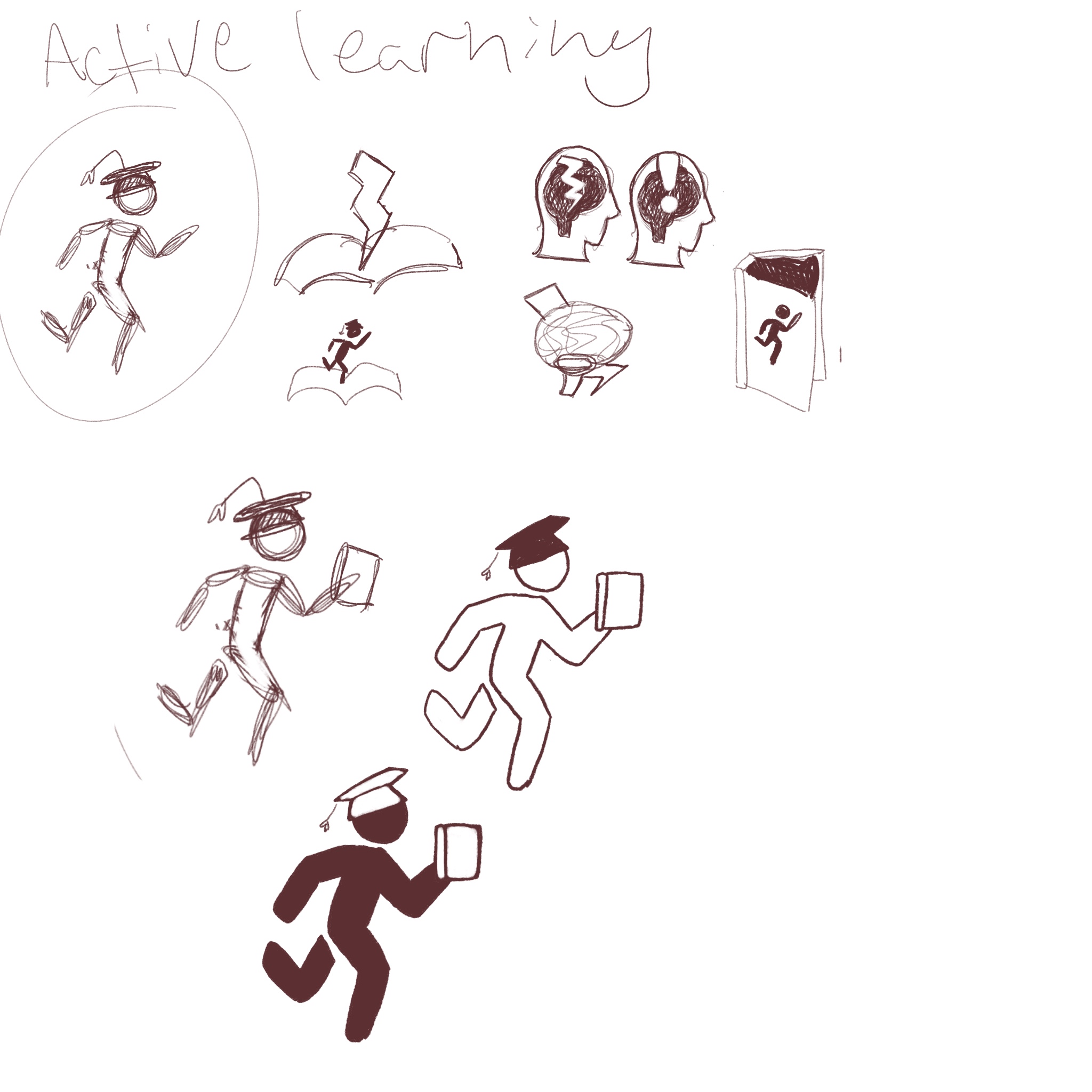
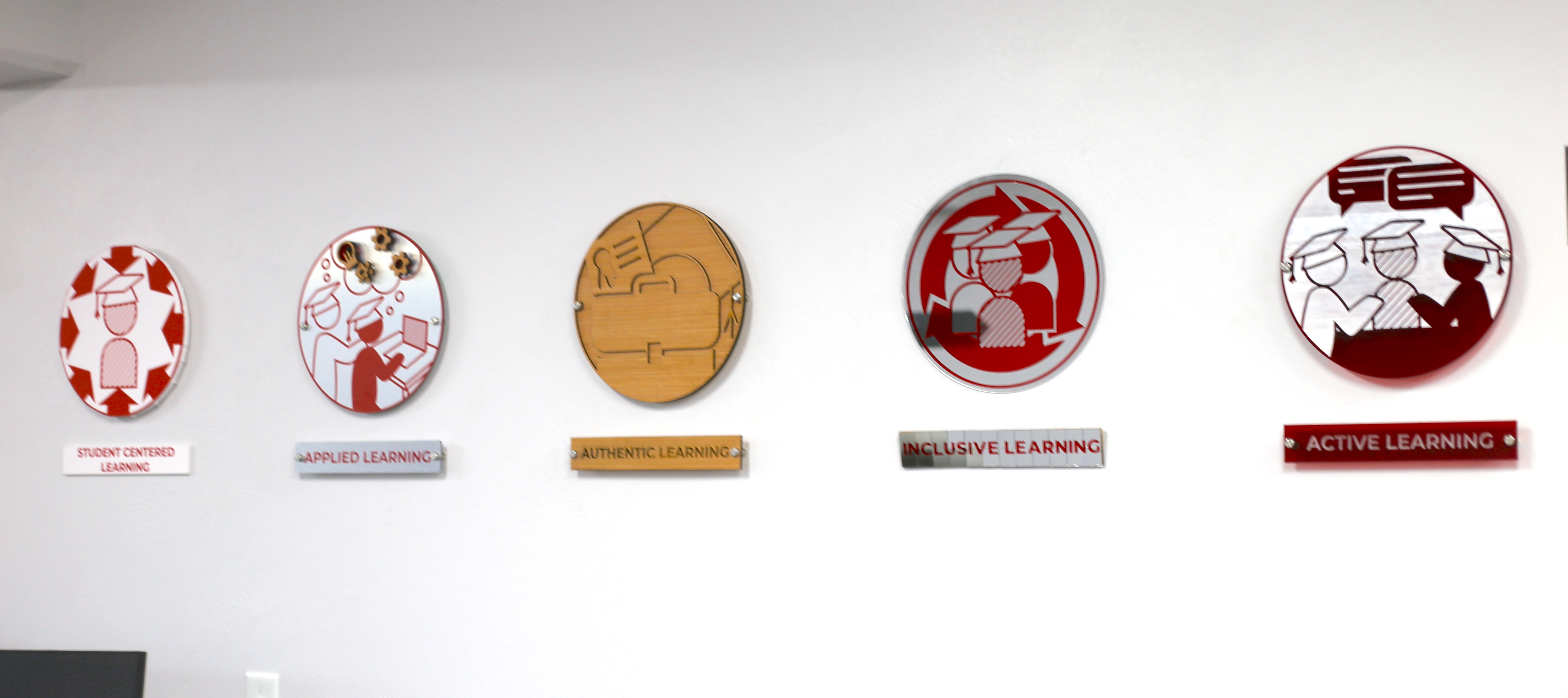
The core instructional plan project was created in part due to the new strategic plan released by Utah Tech University for the 2020-2025 period. The assignment was to create icons for the five new instructional methods. In addition to designing the icons, wall art was created for each of the icons to be hung in the faculty affairs meeting area, which had up until this point been bare.
The five areas are as follows:

Active Learning
Active learning engages students to fully participate in their learning by thinking, discussing, investigating, and creating. Active learning can take many forms and be executed in any discipline. In active learning classrooms, students practice skills, solve problems, struggle with complex questions, propose solutions, and explain ideas in their own words through writing and discussion. Research indicates that active learning methods are especially effective for student learning.

Applied Learning
Applied learning refers to an educational approach whereby students learn by engaging in direct application of skills, theories, and models. Students apply knowledge and skills to hands-on or career settings, creative projects or independent or directed research. The applied learning experience can occur outside of the traditional classroom or be embedded as part of a course. Research indicates that applied learning increases student motivation and promotes success. Some examples of applied learning are as follows:
- Service learning
- Community service
- Civic engagement
- Creative works
- Research/undergraduate research
- Entrepreneurship project
- Field study
- Study approach
- Mentoring

Authentic Learning
Authentic learning connects what students learn in the classroom to real-world issues, problems and applications within contexts that closely approximate the workplace. Authentic learning helps students understand the relevance of what they are learning and how they can apply their skills in the professional world. Students confront open-ended problems and/or grapple with ambiguity that result in interdisciplinary learning. Research indicates authentic learning improves critical thinking, increases engagement and motivation, increases information retention, and promotes teamwork and collaboration.
- Internship—credit or non-credit
- Clinical experience
- Practicum
- Simulations

Inclusive Learning
Inclusive learning provides students the opportunity to equally access, use, and acquire tools to understand learning content. Students, along with their contributions within the learning environment, are equally valued and respected regardless of their social identities. Learning activities are intentionally designed to remove barriers and support a variety of learning modalities, abilities, and backgrounds. Faculty members may
- offer curriculum materials that include multiple voices, identities, and perspectives.
- deliver a variety of course content through methods such as lectures, readings, videos, discussions, etc.
- create a variety of assignment types and provide students with choices in how they complete an assignment.
- create multiple forms of assessment, feedback, and demonstrations of learning.

Student-centered Learning
Student-centered learning is personalized, cooperative, collaborative and community-oriented with a high degree of student engagement in self-directed projects that are culturally and socially relevant to students. Students construct their own knowledge through a blend of individual and collaborative work to build capacities that apply to 21st century skills and abilities. Personal technology is used to produce as well as consume disciplinary content. Students take ownership over their own learning, support each other’s progress, and celebrate successes. Assessments are frequent, including self-assessments by the students, to ensure the requisite content is mastered.
Throughout the process, I worked with various coworkers and administration to brainstorm ideas for the five areas, as well as refine them into icons that could be easily identified in future branding. Once the icons were perfected, they were built in the university's Makerspace, using laser and vinyl cuttings of various materials.
In the end, the finished projects were hung in the Faculty Affairs office, and to my knowledge still remain their on display.